



Understanding the Expansion & Contraction Cycle
1. The Expansion: Hydrostatic Pressure
When Michigan experiences heavy spring rains or rapid snowmelt, the clay soil absorbs water and swells significantly. This creates hydrostatic pressure—a force so powerful it can exert thousands of pounds of pressure against your basement walls. This is the primary reason for “bowing” or bulging walls that seem to lean inward toward your basement.
2. The Shrinkage: The Summer Settlement
During our dry, hot July and August months, that same clay “sponge” loses its moisture and shrinks. As the soil pulls away from your foundation, it leaves a void. Without the soil there to support the weight of the concrete, your foundation begins to sink (or “settle”) into the gaps.
The 26-Inch Miracle: Is It Ever “Too Late”?
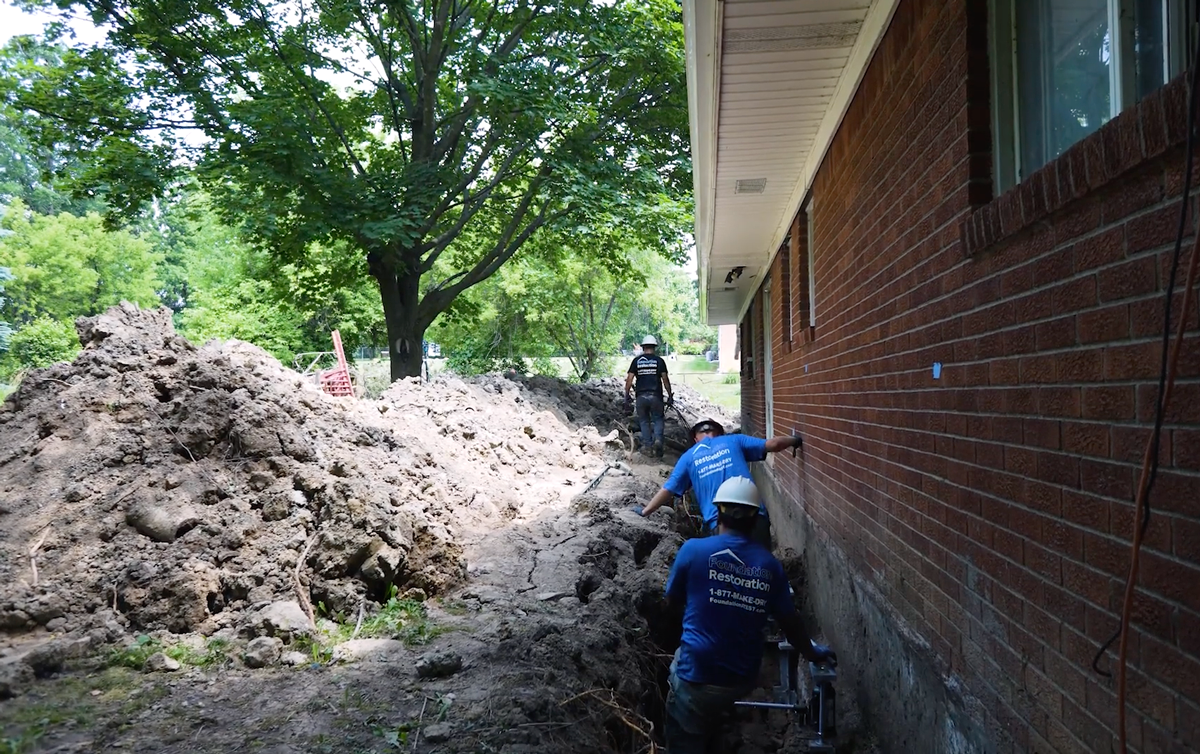
We recently encountered a local Michigan home that had settled a staggering 26 inches. Most contractors took one look and walked away, deeming it a total loss. However, our team was able to “resurrect” the structure using a combination of:
-
Helical Piers: Steel shafts bored deep into stable load-bearing soil to jack the house back to its original height.
-
High-Density Injections: Specialized structural foam used to fill voids and stabilize the loose soil around the perimeter.
The takeaway? If a house can be saved after moving two full feet, it’s quite possible your home can be saved too.
Top 3 Warning Signs to Look For
Because Michigan soil is so active, you should perform a “perimeter check” of your home twice a year. Look for these three red flags:
1. Stair-Step Cracks
Check your exterior brickwork or cinder block. If you see cracks following the mortar lines in a staircase pattern, your foundation is unevenly shifting. This is a clear sign that one corner of your home is “dropping” faster than the rest.
2. Sticking Doors and Windows
Before you blame the humidity for a stuck door, check the frame. When a foundation settles, the house loses its “square.” If a door suddenly won’t latch or a window is jammed shut, the skeletal frame of your house is likely shifting.
3. Horizontal Basement Cracks
Unlike vertical hairline cracks (which are often just minor shrinkage), horizontal cracks are a structural emergency. This indicates that the “sponge” effect is pushing your walls inward. If left untreated, these walls can eventually collapse.
Think your foundation is shifting?
Don’t wait for a 26-inch drop. Early intervention is the difference between a simple stabilization and a total reconstruction. Call 877-MAKE-DRY for a free inspection.